
Home
Try (Un)Perplexed Spready for Free: AI Spreadsheets Without Barriers
- Details
- Written by Super User
- Category: (Un)Perplexed Spready
Try (Un)Perplexed Spready for Free: AI Spreadsheets Without Barriers
Introduction
At Matasoft, we have always believed that the best way to understand a tool is to use it on your own data. Demos and tutorials are helpful, but nothing beats the moment when you type a formula into your own spreadsheet and watch an AI model fetch, analyse, and summarise real information right before your eyes.
Until now, trying (Un)Perplexed Spready's AI features required either a license key or a local Ollama installation. With version 1.3.0, that changes. We are introducing a freemium tier that lets anyone use the full set of AI spreadsheet formulas -- without a license, without a credit card, and without any software installation beyond (Un)Perplexed Spready itself.
In this article, we explain what the freemium tier includes, how it works, and the two paths you can take to start experimenting today -- one for users who want to install their own local AI model, and one for users who just want to type a formula and see results immediately.
What Is the Freemium Tier?
Starting with version 1.3.0, (Un)Perplexed Spready no longer blocks AI formulas when no license key is present. Instead, unlicensed users receive a daily quota of 500 AI calculations -- completely free of charge. Once the quota is reached, formulas return a clear #LIMIT message indicating that the daily limit has been reached. The counter resets automatically at midnight.
A new status bar at the bottom of the main window shows your current usage in real time:
Free tier: 47/500 AI calculations today-- normal usageFree tier: 460/500 — approaching daily limit-- when you reach 90%License: Active (unlimited)-- after you enter a license key
When you enter a valid license key (via Help → About → Enter License), the quota is removed entirely and the status bar switches to License: Active (unlimited). Spready will also offer to recalculate any cells that previously returned #LIMIT so you can pick up right where you left off.
Which formulas are included? All of them. The freemium quota covers every AI-powered formula family:
=PERPLEXITY1/2/3/4/5()-- Perplexity AI (up to 5 input ranges)=ASK_LOCAL1/2/3/4/5()-- locally installed AI models (up to 5 input ranges)=ASK_REMOTE1/2/3/4/5()-- AI model hosted on Matasoft's server (up to 5 input ranges)=ASK_LOCAL_WEB1/2/3/4/5()-- local AI with web search (up to 5 input ranges)=ASK_REMOTE_WEB1/2/3/4/5()-- remote AI with web search (up to 5 input ranges)=WEBSEARCH()/=WEBSEARCH1()-- direct web search with AI summarisation
Every formula that a licensed user can run, a free-tier user can run too -- just with the daily limit.
Two Paths to Get Started
There are two ways to power the AI formulas in (Un)Perplexed Spready. You can use either one -- or both -- depending on your needs and technical comfort level.
| Path | Formula Family | What You Need | Best For |
|---|---|---|---|
| Path 1: Bring Your Own AI | =ASK_LOCAL*()=ASK_LOCAL_WEB*() |
Install Ollama on your computer and download any model that fits your hardware (Mistral 7B, DeepSeek, Llama, GLM, and many more). Point Spready at localhost:11434 in Settings → Ask Local API Settings. |
Privacy-conscious users, developers, and anyone who wants full control over the model, the data, and the cost. Everything runs on your machine -- no data ever leaves your computer. |
| Path 2: Use Our Server | =ASK_REMOTE*()=ASK_REMOTE_WEB*() |
Nothing. No Ollama installation, no API keys, no configuration. The =ASK_REMOTE formulas are pre-configured to use an AI model hosted on Matasoft's server, accessible over a secure HTTPS connection. Just type the formula and press Enter. |
Users who want to evaluate the product instantly -- zero setup, zero installation, zero cost. Perfect for trying the demo spreadsheets and exploring what AI-powered spreadsheets can do. |
Path 1: Install Your Own Ollama (ASK_LOCAL)
If you want full control -- and you are comfortable installing software on your machine -- this is the path for you. Ollama is a free, open-source tool that runs AI models locally. Installation takes minutes:
- Download Ollama from https://ollama.com/ (available for Windows, macOS, and Linux)
- Open a terminal and run:
ollama pull mistral7b(or any model you prefer) - In (Un)Perplexed Spready, go to Settings → Ask Local API Settings and confirm the URL is set to
http://localhost:11434/api/chat - Type
=ASK_LOCAL1(A2, "Summarise this in one sentence")in any cell
That's it. The model runs entirely on your computer. No internet connection is required for the AI itself (only for web search formulas). Your data never leaves your machine. And thanks to the freemium tier, you can do this up to 500 times per day without a license.
Modern small models like Mistral 7B, DeepSeek-1:7B, and Llama can run even on modest hardware. Ollama handles the model lifecycle -- you just pull a model and start using it.
Path 2: Use Our Server, No Installation Required (ASK_REMOTE)
If you just want to see what an AI-powered spreadsheet can do -- without installing anything beyond (Un)Perplexed Spready itself -- the =ASK_REMOTE family is your starting point.
These formulas are pre-configured to use an AI model hosted on Matasoft's server. The connection is encrypted via HTTPS. You do not need an API key, you do not need to configure any settings, and you do not need to install Ollama or any other software. Just type the formula:
=ASK_REMOTE1(A2, "What industry does this company operate in?")
Press Enter, and the cell will display the AI's answer within seconds. The =ASK_REMOTE_WEB variants add web search capability -- the model can search the internet for up-to-date information before answering.
Note: The Matasoft-hosted model is intended for evaluation and testing, not for production workloads. The hosting server has limited hardware, so calculations may be slower than a local model. For sustained use, we recommend installing your own Ollama (Path 1) or subscribing to Ollama Cloud.
How the Daily Quota Works
The freemium quota is designed to be generous enough for genuine evaluation while preventing automated abuse. Here are the details:
| Aspect | Detail |
|---|---|
| Daily limit | 500 AI calculations per day (resets at midnight, local time) |
| What counts as one calculation? | Each formula evaluation that reaches the AI model counts as one. Deferred calculations (when Defer Calculation is enabled) do not consume quota. Formula errors and argument-validation failures do not consume quota. |
| What happens at the limit? | The cell shows #LIMIT: Daily free limit reached (500 AI calculations per day). Please upgrade to premium for unlimited usage. |
| Quota tracking | The counter is stored locally in a usage file on your machine. It is not sent to any server. A checksum protects against manual tampering. |
| Licensed users | No quota. Licensed users have unlimited AI calculations with no daily limit. |
When you open a spreadsheet with many AI formulas, Spready's Defer Calculation feature is active by default. This means formulas are not evaluated automatically on file open -- they wait for you to trigger a recalculation explicitly. This prevents accidentally consuming your entire daily quota when opening a large spreadsheet.
What About Web Search?
Web search formulas (=ASK_LOCAL_WEB, =ASK_REMOTE_WEB, and =WEBSEARCH) are also included in the freemium tier. Each web-search-enabled formula evaluation counts as one calculation against your daily quota.
For =ASK_LOCAL_WEB formulas, you will need to configure at least one web search engine in Settings → Web Search Settings. Spready supports nine built-in engines (SearXNG, Brave Search, DuckDuckGo, Google CSE, Bing, Mojeek, Startpage, Wikipedia, and Wikidata), plus Ollama Web Search for Ollama Cloud subscribers. Read our previous article for a detailed comparison: Web Search Features in (Un)Perplexed Spready.
For =ASK_REMOTE_WEB formulas, web search is handled on the Matasoft server side -- no additional configuration needed.
Demonstration: Enriching German Craft Trades Data with =ASK_LOCAL_WEB5 and =ASK_REMOTE_WEB5
To show how the freemium tier works in practice, we prepared a demonstration spreadsheet containing 60 German craft trade companies -- real businesses from trades such as refrigeration, electrical, roofing, plumbing, and HVAC. The goal: enrich each company's record with its full physical address, email contact, and phone number, using only the company name, city, website URL, and two description fields as input.
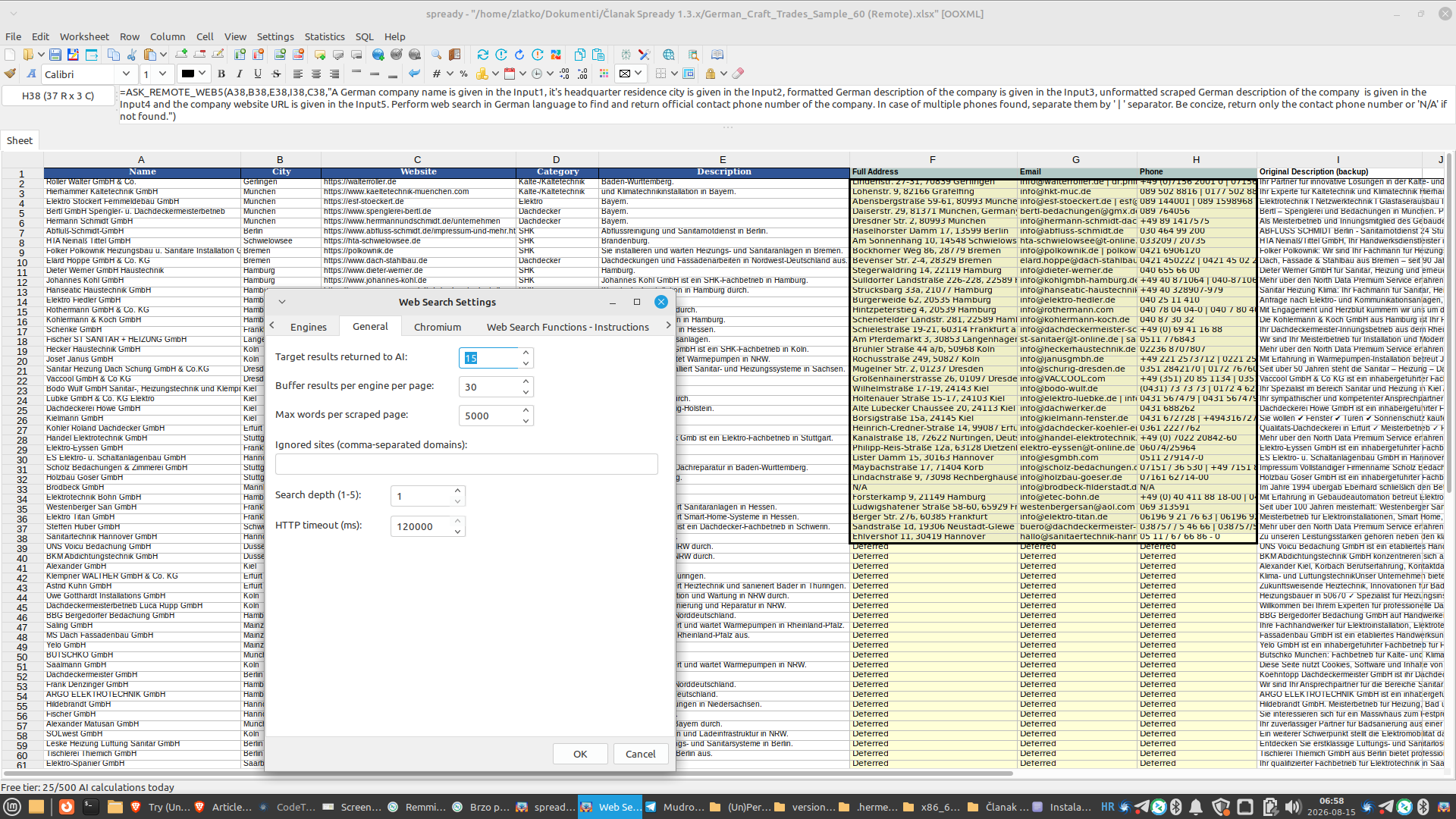
We ran the same spreadsheet twice -- once with =ASK_LOCAL_WEB5 (using a locally installed Ollama model) and once with =ASK_REMOTE_WEB5 (using the Matasoft-hosted model). Both variants produced identical results -- the only difference was the AI endpoint.
Screenshot with locally installed Ollama and ASK_LOCAL_WEB formulas used: 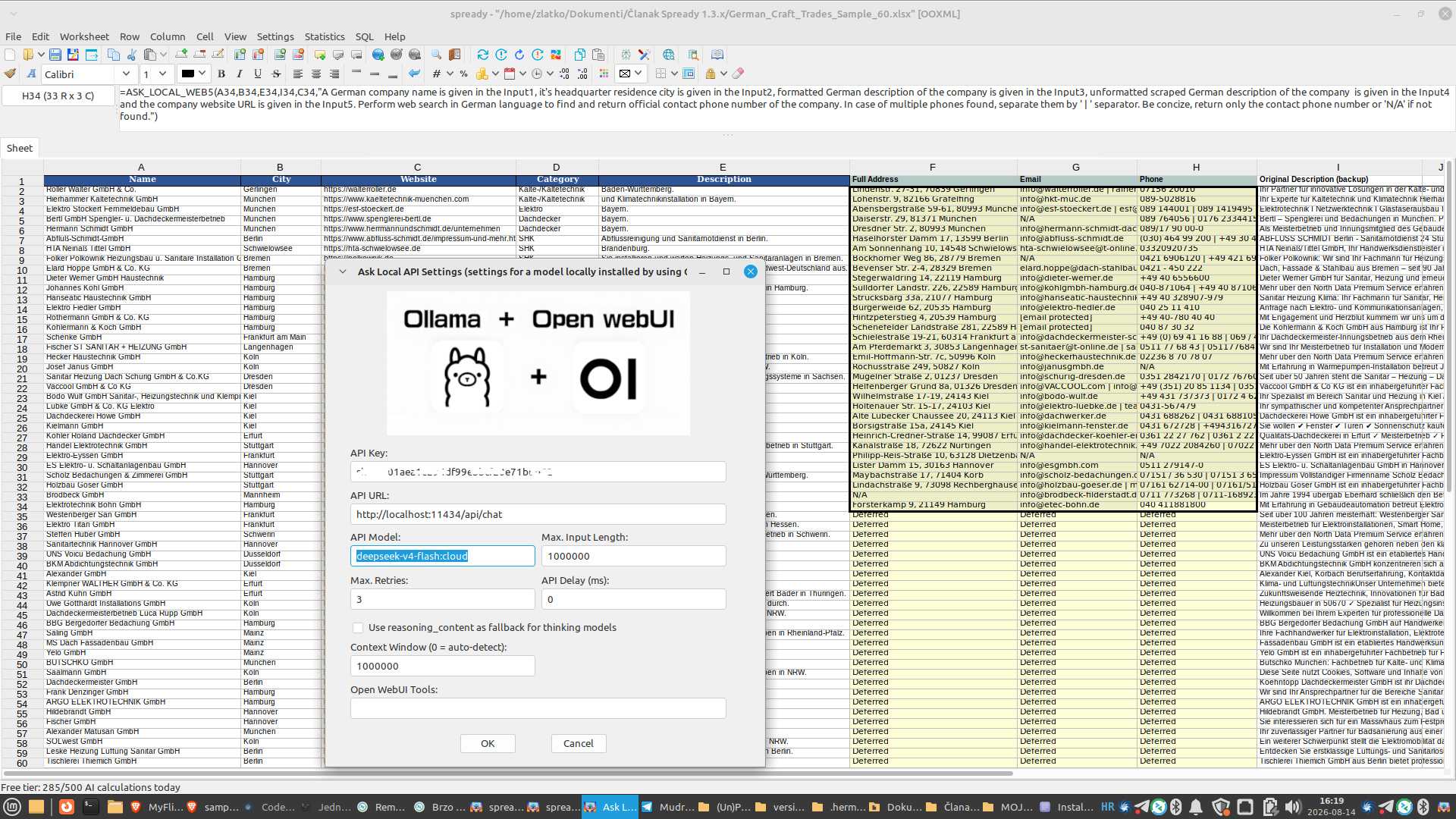
Screenshot with ASK_REMOTE_WEB formulas used (Ollama installed on our server):
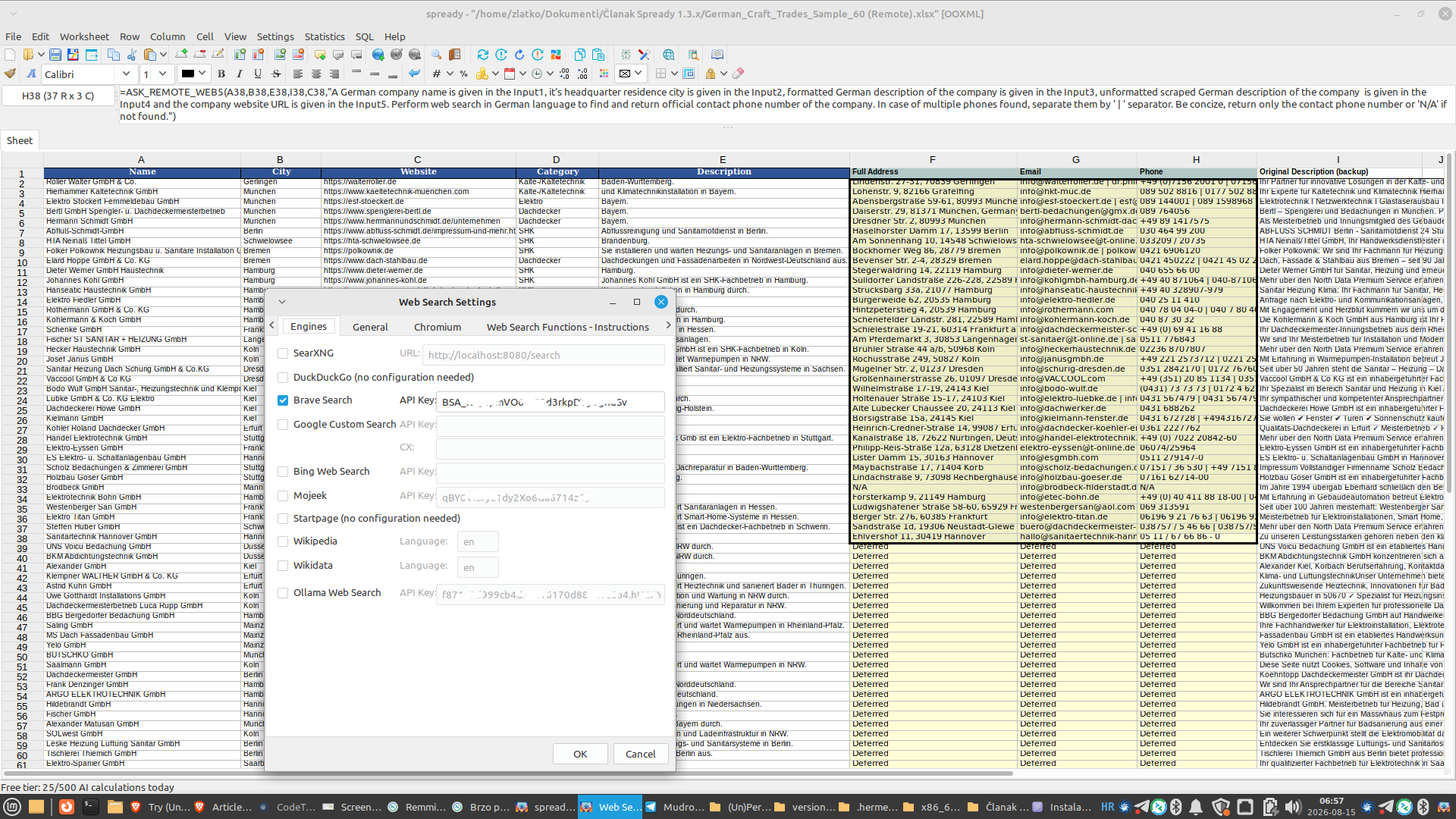
The Spreadsheet Structure
The spreadsheet contains 60 rows (one per company) and 9 columns:
| Column | Header | Source |
|---|---|---|
| A | Name | User input -- company name (e.g., Roller Walter GmbH & Co.) |
| B | City | User input -- headquarters city (e.g., Gerlingen) |
| C | Website | User input -- known website URL (e.g., https://walterroller.de) |
| D | Category | User input -- trade category (e.g., Kälte-/Kältetechnik) |
| E | Description | User input -- formatted German company description |
| F | Full Address | AI-generated -- formula in column F |
| G | AI-generated -- formula in column G | |
| H | Phone | AI-generated -- formula in column H |
| I | Original Description (backup) | User input -- raw scraped German description (unformatted) |
The Formulas
Columns F, G, and H each contain an AI formula that passes five input ranges to the model. This is the =ASK_LOCAL_WEB5 variant -- the highest-input formula in the family, accepting up to 5 cell ranges plus a prompt string:
Column F -- Full Address (ASK_LOCAL_WEB5)
=ASK_LOCAL_WEB5(A2, B2, E2, I2, C2, "A German company name is given in the Input1, it's headquarter residence city is given in the Input2, formatted German description of the company is given in the Input3, unformatted scraped German description of the company is given in the Input4 and the company website URL is given in the Input5. Perform web search in German language to find and return official physical address of the company headquarter. Be concise, return only the full physical address of the company or 'N/A' if not found.")
Column G -- Email (ASK_LOCAL_WEB5)
=ASK_LOCAL_WEB5(A2, B2, E2, I2, C2, "A German company name is given in the Input1, it's headquarter residence city is given in the Input2, formatted German description of the company is given in the Input3, unformatted scraped German description of the company is given in the Input4 and the company website URL is given in the Input5. Perform web search in German language to find and return official email contact of the company. In case of multiple emails found, separate them by ' | ' separator. Be concise, return only the contact email accounts or 'N/A' if not found.")
Column H -- Phone (ASK_LOCAL_WEB5)
=ASK_LOCAL_WEB5(A2, B2, E2, I2, C2, "A German company name is given in the Input1, it's headquarter residence city is given in the Input2, formatted German description of the company is given in the Input3, unformatted scraped German description of the company is given in the Input4 and the company website URL is given in the Input5. Perform web search in German language to find and return official contact phone number of the company. In case of multiple phones found, separate them by ' | ' separator. Be concise, return only the contact phone number or 'N/A' if not found.")
Remote Variant -- =ASK_REMOTE_WEB5
The =ASK_REMOTE_WEB5 variant uses exactly the same syntax -- the only difference is the formula name. Simply replace ASK_LOCAL_WEB5 with ASK_REMOTE_WEB5 and the formulas will run against the Matasoft-hosted AI model instead of your local Ollama:
=ASK_REMOTE_WEB5(A2, B2, E2, I2, C2, "A German company name is given in the Input1, ...")
Understanding the Five Input Parameters
The =ASK_LOCAL_WEB5 and =ASK_REMOTE_WEB5 formulas accept five cell ranges followed by a prompt string. The model receives each range as a numbered input (Input1 through Input5) and can use all of them to decide whether a web search is needed and how to interpret the results:
| Parameter | Cell Range | Content |
|---|---|---|
| Input1 | A2 |
Company name -- the entity to look up (e.g., Roller Walter GmbH & Co.) |
| Input2 | B2 |
City -- headquarters location (e.g., Gerlingen) |
| Input3 | E2 |
Formatted description -- a clean, human-readable German company description |
| Input4 | I2 |
Original description -- raw scraped text from the company's website (unformatted) |
| Input5 | C2 |
Website URL -- the company's known homepage (e.g., https://walterroller.de) |
| Prompt | string literal | Instruction telling the AI what to search for and how to format the result |
Why five inputs? Because a company name alone is often ambiguous -- there may be dozens of businesses called Schmidt GmbH in Germany. By providing the city, both descriptions, and the website URL, the model can construct a precise search query and disambiguate results that match multiple entities. The model decides for itself whether a web search is needed -- if the answer is already available from the provided context, it can skip the search and answer directly.
How to Run This Demonstration Yourself
With the freemium tier, you can run this entire demonstration for free:
- Option A (zero setup): Download the Remote variant of the spreadsheet, open it in (Un)Perplexed Spready, and trigger a recalculation. The
=ASK_REMOTE_WEB5formulas will run against the Matasoft-hosted AI model. No Ollama installation needed. - Option B (your own AI): Download the Local variant, install Ollama with any model, and run the
=ASK_LOCAL_WEB5formulas. Everything runs on your machine.
With 60 companies × 3 formula columns = 180 AI calculations, this demonstration fits comfortably within the free daily quota of 500.
Ready to Try?
Getting started takes less than five minutes:
- Get (Un)Perplexed Spready -- you have two options:
- Download the desktop application and install it on your computer (Windows or Linux): https://matasoft.hr/QTrendControl/index.php/un-perplexed-spready/un-perplexed-spready-download
- Try online in your browser -- no installation required, use the web-hosted version of (Un)Perplexed Spready directly: https://spready.matasoft.hr/
- Install and launch the application. No license key required -- the freemium tier is active by default.
- Try a formula -- pick whichever path suits you:
- Zero setup: Type
=ASK_REMOTE1(A2, "What does this company do?")and press Enter - With your own AI: Install Ollama, then type
=ASK_LOCAL1(A2, "What does this company do?")and press Enter - Watch the status bar at the bottom of the window to track your remaining daily calculations.
- When you're ready for unlimited usage, purchase a license key from https://spready.matasoft.hr/ and enter it via Help → About → Enter License.
Conclusion
Version 1.3.0 removes the last barrier between you and AI-powered spreadsheets. Whether you want to run models privately on your own hardware with =ASK_LOCAL, or just type a formula and see results with =ASK_REMOTE -- you can start today, for free, with 500 AI calculations every day.
We can't wait to see what you build with it.
Further Reading
Matasoft Articles on (Un)Perplexed Spready
- Article #161: (Un)Perplexed Spready -- Native Web Search Explained and Demonstrated -- Web search engines, formula families, and practical comparison
- Article #150: (Un)Perplexed Spready with web search enabled Ollama models -- Phase 1: Open WebUI + SearXNG setup on Linux
- Article #152: An example of using (Un)Perplexed Spready in a real life use case - Furniture catalog taxonomy classification -- Phase 2: Matasoft Web Search and Web Reader tools
- Article #156: (Un)Perplexed Spready v1.2.X -- Web Search in (Un)Perplexed Spready -- Phase 3: Native web search with 9 engines
- Web Search Features in (Un)Perplexed Spready -- Phase 4: Ollama Web Search engine and expanded inputs
External Resources
- Ollama -- Download and install local AI models
- Ollama documentation -- Model management, API reference
Other Topics
Download (Un)Perplexed Spready v1.3.0 and start experimenting today. No license required -- just install and type a formula. Get it here: https://matasoft.hr/QTrendControl/index.php/un-perplexed-spready/un-perplexed-spready-download or try it online at https://spready.matasoft.hr/
© 2026 Matasoft. All rights reserved. (Un)Perplexed Spready is a product of Matasoft.
(Un)Perplexed Spready native Web Search Explained and Demonstrated
- Details
- Written by Super User
- Category: (Un)Perplexed Spready
Web Search Features in (Un)Perplexed Spready
Introduction
At Matasoft, we believe that technology exists to amplify human creativity, not to burden it with repetitive and tedious tasks. Yet, countless professionals still spend hours manually searching the web for information that should be automated -- looking up company websites, contact pages, regulatory data, market intelligence, and dozens of other routine lookups that the modern web was designed to expose programmatically.
(Un)Perplexed Spready is a spreadsheet application that combines the power of traditional spreadsheets with advanced AI capabilities. Version 1.2.X brought a revolutionary integration of web search directly into spreadsheet cells -- read all about it in our previous article Web Search in (Un)Perplexed Spready v1.2.X.
Recently, in version 1.2.6, we have taken the next logical step. The new release introduces:
- Ollama Web Search as a fully integrated search engine -- no middleware, no Docker containers, no Open WebUI required
- Extended input ranges for the
=ASK_LOCAL_WEBand=ASK_REMOTE_WEBformula families -- from a single input up to five inputs - Improved engine orchestration that makes the choice of search engine a one-click decision
In this article, we will demonstrate how the same spreadsheet task -- enriching a list of U.S. school districts with their official web pages -- can be performed using three different web search engines: Ollama Web Search, Brave Search, and SearXNG. The results will show the strengths and trade-offs of each engine, helping you choose the one that best fits your workflow.
The Evolution of Web Search in (Un)Perplexed Spready
Web search in Spready has evolved through four distinct phases since its introduction. Understanding this evolution helps to appreciate the design decisions behind recent enhancements and the role of each engine.
Phase 1: Open WebUI + SearXNG Middleware (Article #150: (Un)Perplexed Spready with web search enabled Ollama models)
The first web search integration required a three-service stack:
- Ollama -- local LLM runtime (or Ollama Cloud endpoint)
- Open WebUI -- chat interface that exposes a chat-completions-compatible API
- SearXNG -- self-hosted meta-search engine running in Docker
Spready would send prompts to the Open WebUI endpoint, which would forward them to Ollama. When the model decided it needed web information, it would call the web_search tool exposed by Open WebUI, which in turn would query SearXNG. This setup was fully self-hosted and privacy-friendly, but complex to install and maintain. Read the complete setup guide in (Un)Perplexed Spready with web search enabled Ollama models.
Phase 2: Matasoft Web Search and Web Reader Tools (Article #152: An example of using (Un)Perplexed Spready in a real life use case - Furniture catalog taxonomy classification)
While the Open WebUI + SearXNG stack worked, it had limitations -- most notably, page content was not fetched in a way that handled JavaScript-heavy websites well. To address this, Matasoft developed two custom Open WebUI tools:
matasoft_web_search-- SearXNG-based search with enhanced result formattingmatasoft_web_reader-- BeautifulSoup + Selenium hybrid that detects whether a page is server-rendered (HTML) or client-rendered (JavaScript SPA) and applies the appropriate fetching strategy
These tools were validated in a real-life use case: classifying 2,751 furniture catalog products into a 129-category taxonomy. The demonstration showed that with the right tools, Spready could handle production-scale data enrichment tasks. See An example of using (Un)Perplexed Spready in a real life use case - Furniture catalog taxonomy classification for the full case study.
Phase 3: Native Web Search in Spready v1.2.X (Article #156: (Un)Perplexed Spready v1.2.X -- Web Search in (Un)Perplexed Spready)
Version 1.2.X was the largest release in Spready's history. It introduced a native web search subsystem that eliminated the need for an Open WebUI middleware in most cases. Key features:
- 9 built-in search engines -- SearXNG, DuckDuckGo, Brave Search, Google Custom Search, Bing Web Search, Mojeek, Startpage, Wikipedia, Wikidata
- 3 formula families --
=WEBSEARCH(),=ASK_LOCAL_WEB(),=ASK_REMOTE_WEB() - Chromium-based page content fetching for deep page reading
- Configurable per-engine in
Settings -> Web Search Settings
Open WebUI integration remained supported as a fallback for users with existing Open WebUI deployments. For the complete v1.2.X feature walkthrough, see (Un)Perplexed Spready v1.2.X -- Web Search in (Un)Perplexed Spready.
Phase 4: Ollama Web Search Engine and Expanded Inputs (v1.2.6, This Article)
Version 1.2.6 brings two key additions:
- Ollama Web Search as a first-class engine -- When your Ollama endpoint supports it, Spready can request web search results directly from Ollama's runtime without any external service. The integration is a single checkbox in
Settings -> Web Search Settings. - Five-input range variants --
=ASK_LOCAL_WEB2(),=ASK_LOCAL_WEB3(),=ASK_LOCAL_WEB4(),=ASK_LOCAL_WEB5()(and corresponding=ASK_REMOTE_WEB*()variants) allow the model to consider up to five context fields when deciding what to search for and how to interpret the results.
In this article we will focus on Phase 4, with a practical demonstration comparing the three most relevant engines.
What Can Web Search Do For You?
In Spready v1.2.6, every web-search-capable formula fits into five use-case families. You don't need to learn the families up-front -- the formula name tells you what to expect:
| Formula | What it does | When to use it |
|---|---|---|
=ASK_LOCAL_WEB(...)=ASK_REMOTE_WEB(...) |
Asks your AI "you may search the web if you need to". The model decides whether to search or answer from its own knowledge. Comes in six variants (0..5) for one to six input values. |
The preferred, straight-forward approach. No external web search tools needed, just (Un)Perplexed Spready and Ollama endpoint. When you want to keep things simple and use the AI endpoint (typically Ollama endpoint) directly, without setting additional layer of Open WebUI middleware and web search tools. When the user just wants an up-to-date answer and trusts the model to know when to search. This is the family we demonstrate below. |
=ASK_LOCAL(...)=ASK_REMOTE(...) |
Plain chat with the AI -- no built-in web search. But: if you connect the endpoint to an Open WebUI server and switch on tools in the settings, Open WebUI can still search the web for you behind the scenes. |
In this approach web search can be established too, but it requires additional Open WebUI middleware installation and setup. Web search runs through Open WebUI with web tools configured. Moreover, Open WebUI can bridge LLM models of other providers, not only Ollama. |
=WEBSEARCH(...) |
Always searches the web first, then asks the AI to summarise the results. The model has no say -- search is mandatory. | When you know you need fresh data and don't want to rely on the model's training knowledge. Good for "look this up" tasks where the model otherwise might guess. |
=PERPLEXITY(...) |
Sends the question straight to Perplexity.ai's cloud. Perplexity does the search and returns an answer with citations. Spready is not in the loop. | When you already have a Perplexity Pro / Max subscription and want the highest-quality synthesised answers without configuring anything on Spready's side. |
Each family comes in six variants named =FAMILY0 through =FAMILY5, accepting one to six input values (input ranges + prompt) respectively. The bare alias =ASK_LOCAL_WEB is shorthand for the single-input variant =ASK_LOCAL_WEB,.where no input ranges are given, only input prompt. Pick the variant that matches how many fields you want to feed in.
Three Ways to Get Web Search Done
Regardless of which family you pick, the actual web search is performed by one of three web search backends:
| Backend | How it works | Who's it for |
|---|---|---|
| Spready's built-in engines (SearXNG, DuckDuckGo, Brave, Google CSE, Bing, Mojeek, Startpage, Wikipedia, Wikidata) |
Spready calls one or more search engines you have enabled in Settings -> Web Search Settings -> Engines, deduplicates the results, and feeds them to the AI for summarising. | Users who want full control over the search backend -- pick the engines you trust, configure your own API keys, or self-host SearXNG for maximum privacy. |
| Ollama Web Search (paid, via Ollama Cloud) |
A shortcut that hands the search off to the Ollama runtime itself. Tick the Use Ollama Web Search box in Web Search Settings -> General and Ollama returns cited results directly. | Ollama Cloud subscribers (Pro or Max) who want the simplest setup -- no engine configuration, no API keys, results come back already cited. |
| Perplexity Cloud (paid, Perplexity.ai) |
Bypasses Spready entirely. The =PERPLEXITY* family calls Perplexity's API directly. Spready never sees the search -- Perplexity does the work and returns the answer. |
Users who want Perplexity's premium answer quality and are happy to pay per query. |
In this article we demonstrate all three backends head-to-head: Ollama Web Search (Ollama-native, fastest path), Brave Search (Spready-managed, cloud API), and SearXNG (Spready-managed, self-hosted). This gives a fair head-to-head comparison of a speed-first, a quality-first, and a privacy-first option.
Practical rule of thumb: If you use locally installed Ollama models, start with =ASK_LOCAL_WEB*(...) with some of the free engines to get idea how it works. If you are existing Ollama Cloud Pro or Max subscriber, use Ollama Web Search engine — it is by far the fastest option (our test completed in under 2 hours vs. 28+ hours for Brave and 94+ hours for SearXNG). Use Brave Search if you need the highest result quality and video/livestream discovery, and you are willing to pay Brave Search API costs. Use SearXNG if you want a free, privacy-first deep search, know how to setup SearXNG, and time is not a limiting factor. If you don't want to setup Ollama or anything else, you are already Perplexity subscriber and willing to pay high costs of API usage, then =PERPLEXITY*(...) with web search included out-of-box is an option.
The Multi-Range Variants -- Why They Matter
In real-world spreadsheets, the relevant context for a single record is rarely contained in one cell. A school district is identified by name + state + county + city, not by name alone. A product is identified by SKU + name + category + manufacturer, not by SKU alone.
The multi-range variants of =ASK_LOCAL_WEB allow the model to see all of these context fields in a single call. When the model decides to perform a web search, it can construct a more precise query (e.g., "Waskom Independent School District Harrison County Texas") and can also disambiguate results that match multiple entities.
Example formula used in the demonstration below:
=ASK_LOCAL_WEB3(A2, B2:D2, E2, Prompts!$B$1)
Where:
A2-- School District name (the entity you're looking up)B2:D2-- State, County, City (3-cell range -- disambiguates the district from others with the same name)E2-- Home Page URL (optional, used if already known from a previous step)Prompts!$B$1-- The instruction template, kept on thePromptssheet so the formula stays short and reusable
At-a-Glance Comparison
| Engine / Method | Internal Path | Triggered by | Setup | Cost | Privacy | Best For |
|---|---|---|---|---|---|---|
| SearXNG (one of 9 native engines) | Path 1 -- Spready-managed | =WEBSEARCH* and =*_WEB* with Ollama Web Search off |
Medium (install SearXNG, point Spready at it) | Free, self-hosted | High (queries never leave your machine) | Privacy-conscious users; air-gapped or LAN-only setups |
| Brave Search (one of 9 native engines) | Path 1 -- Spready-managed | =WEBSEARCH* and =*_WEB* with Ollama Web Search off |
Low (just an API key in Web Search Settings) | Free tier 2,000 queries/month, then paid | Medium (queries sent to Brave's cloud) | High-quality results with minimal setup |
| Ollama Web Search (native Ollama feature) | Path 2 -- Ollama-native | =*_WEB* with Ollama Web Search on and Ollama-native endpoint |
Lowest (tick one checkbox in Web Search Settings) | Requires Ollama Pro or Max plan | Medium (search is performed by Ollama's infrastructure) | Existing Ollama Cloud subscribers who want the fastest path from zero to working web search |
Open WebUI tools (e.g. searxng_search) |
Bonus -- Open WebUI-side | =ASK_LOCAL* / =ASK_REMOTE* (suffix-less) with non-empty API_TOOLS and an Open WebUI endpoint |
Medium-High (install Open WebUI, install web-search tool inside it) | Free, self-hosted | High (everything self-hosted) | Users already running Open WebUI who want web search without the nine-engine machinery |
| Perplexity Cloud (vendor API) | Path 3 -- Perplexity Cloud | =PERPLEXITY* / =ASK_PERPLEXITY* |
Lowest (just an API key in Perplexity Settings) | Pay-per-query to Perplexity.ai | Low (queries and context sent to Perplexity) | Best-quality results with zero setup, when privacy is not the priority |
The remainder of this article demonstrates the same =ASK_LOCAL_WEB3 spreadsheet task with all three engines — Ollama Web Search (Path 2), Brave Search (Path 1), and SearXNG (Path 1) — so you can see the practical differences in the output.
*If you ask yourself why =ASK_LOCAL_WEB4 or =ASK_LOCAL_WEB5 have not been used instead of =ASK_LOCAL_WEB3, where logically they would be better choice, the answer is simple - that's because the spreadsheet has been designed before formula variants with 4 or 5 input ranges were introduced, and I was too lazy to redesign the formulas in the sample spreadsheet. 
Demonstration: =ASK_LOCAL_WEB with Three Different Engines
To produce a fair comparison, we ran the same task with the same model (glm-5.2:cloud) on the same spreadsheet -- the only variable being the search engine enabled in Settings -> Web Search Settings.
The Test Project: U.S. School Districts
The spreadsheet Demo42a_School_Districts_ASK_LOCAL_WEB.xlsx contains a list of 50 U.S. school districts. The input columns (A-D) provide identifying information; the result columns (E-H) are filled by =ASK_LOCAL_WEB3 formulas:
| Column | Header | Source |
|---|---|---|
| A | School District | User input |
| B | State | User input |
| C | County | User input |
| D | City | User input |
| E | Home Page | `=ask_local_web3(A2, B2:C2, D2, Prompts!$A$1)` |
| F | Board of Education / Contact Page / Staff Directory | `=ask_local_web3(A2, B2:D2, E2, Prompts!$B$1)` |
| G | Meeting Document Download Page | `=ask_local_web3(A2, B2:D2, E2, Prompts!$C$1)` |
| H | Meeting Videos / YouTube / Livestream | `=ask_local_web3(A2, B2:D2, E2, Prompts!$D$1)` |
Note on F, G, H: Column E's resolved URL is passed as the third argument, so the model can scope its search to the district's own domain.
The Four Prompt Templates
The Prompts sheet contains four instruction templates, one per result column. All four are used across the three engine runs -- only the search engine changes, the prompts stay constant.

Prompt A1 (used in Column E -- Home Page)
You are a web research assistant. INPUTS: - Input1: School District name - Input2: State and County - Input3: City TASK: Find the OFFICIAL WEBSITE HOMEPAGE of this US public school district. DETAILED RULES: 1. Search the web for the school district using its name plus state (and county/city if needed). 2. Identify the official district website, not a: - news article - Wikipedia page - social media page - individual school site - parent/community site 3. Return the ROOT HOMEPAGE of the district: - Example: https://www.lcps.org - NOT a subpage like /about, /schools, /board-of-education 4. If the district is a section inside a larger county or state education website: - Return the URL of the district's specific section page. 5. If you cannot confidently identify the official homepage: - Return exactly: NO_HOMEPAGE_FOUND OUTPUT FORMAT (STRICT): - EITHER: a single URL for the district's homepage (no extra text, no spaces, no quotes) - OR: NO_HOMEPAGE_FOUND
Prompt B1 (used in Column F -- Board of Education / Contact / Staff)
You are a web research assistant. INPUTS: - Input1: School District name - Input2: State, County and City - Input3: Website Home Page TASK: Find the best available BOARD OR LEADERSHIP PAGE for this school district. PRIORITY ORDER (USE THE FIRST THAT EXISTS): 1. Board of Education / School Board page. 2. Administration or Superintendent page. 3. Staff directory. 4. General district contact page (last resort). RESEARCH STEPS: 1. Start from the district's official website if you know it, otherwise search the web. 2. Look for pages with titles like: - "Board of Education" - "School Board" - "Board Members" - "Board of Trustees" - "Administration" - "District Leadership" - "Staff Directory" - "Contact Us" 3. Choose the highest-priority page available from the list above. 4. The URL MUST be: - a page specific to the board, leadership, staff, or district contact - NOT the general homepage - NOT an individual board member's personal profile or personal site. FAILURE CASE: - If you cannot find any suitable board, leadership, staff, or contact page: - Return exactly: NO_BOARD_OR_CONTACT_PAGE_FOUND OUTPUT FORMAT (STRICT): - EITHER: a single URL for the selected page (no extra text, no spaces, no quotes) - OR: NO_BOARD_OR_CONTACT_PAGE_FOUND
Prompt C1 (used in Column G -- Meeting Document Download Page)
You are a web research assistant.
INPUTS:
- Input1: School District name
- Input2: State, County and City
- Input3: Website Home Page
TASK:
Find a page where the school board's MEETING DOCUMENTS are posted for download.
DEFINITION:
The page should list downloadable documents such as:
- agendas
- minutes
- meeting notices
- meeting packets
- board documents
RESEARCH STEPS:
1. Start from the district's website or search the web for:
- "<district name> board agendas"
- "<district name> board minutes"
- "<district name> BoardDocs"
- "<district name> Simbli"
2. Look for:
- A board meetings page with downloadable PDFs or other files.
- OR a third-party platform such as:
- BoardDocs: go.boarddocs.com/...
- Simbli / eBoard Solutions: simbli.eboardsolutions.com/...
- Diligent Community: community.diligent.com/...
- CivicPlus / CivicEngage
- eSCRIBE
- Granicus / Legistar
3. If the district uses a third-party platform:
- Return the PUBLIC board/meetings listing URL on that platform, including any S= or id parameters.
4. The page MUST clearly expose downloadable meeting documents, not just a calendar with dates.
RULES:
- Do NOT return:
- login-only URLs
- Google Drive, Dropbox, or cloud storage folders
- individual PDF file URLs
- pages that only list dates without documents
- If you are unsure whether documents are downloadable, treat it as NOT FOUND.
FAILURE CASE:
- If you cannot find a page with downloadable meeting documents:
- Return exactly: NO_MEETING_DOCUMENTS_PAGE_FOUND
OUTPUT FORMAT (STRICT):
- EITHER: a single URL for the meeting documents page (no extra text, no spaces, no quotes)
- OR: NO_MEETING_DOCUMENTS_PAGE_FOUND
Prompt D1 (used in Column H -- Meeting Videos / YouTube / Livestream)
You are a web research assistant. INPUTS: - Input1: School District name - Input2: State, County and City - Input3: Website Home Page TASK: Find a URL where this school district's BOARD MEETINGS are recorded or livestreamed. WHAT COUNTS: - YouTube channel or playlist for board meetings. - Vimeo channel. - District web page that embeds a livestream or video archive (e.g. Granicus, Swagit, etc.). - Facebook page ONLY if it is clearly used to stream board meetings. RESEARCH STEPS: 1. Search YouTube for: - "<district name> board meeting" - "<district name> school board" 2. Verify the channel or playlist actually belongs to this specific district: - Check the name, logo, description, and video titles. 3. Also check the district's website for links labelled: - "Board Meetings" - "Watch Live" - "Video" - "Livestream" 4. Prefer a CHANNEL or PLAYLIST URL, not a single video URL. 5. If the district streams on Vimeo, Facebook, or another platform: - Return the main page/channel where meetings are posted. RULES: - Do NOT return: - a single one-off video URL - a channel with no board meeting content - unrelated channels with similar district names - If you cannot find any recordings or livestream that clearly correspond to board meetings: - Treat it as NOT FOUND. FAILURE CASE: - If you cannot find a valid video or livestream source for board meetings: - Return exactly: NO_MEETING_VIDEOS_FOUND OUTPUT FORMAT (STRICT): - EITHER: a single URL for the channel/playlist/meeting-video page (no extra text, no spaces, no quotes) - OR: NO_MEETING_VIDEOS_FOUND
The four prompts follow a consistent design pattern:
- Role prefix ("You are a web research assistant.") anchors the model in the right behavior.
- Inputs block echoes the formula arguments so the model knows which input is which.
- Task statement names the specific deliverable in one sentence.
- Rules block is where the prompt engineering effort concentrates -- it tells the model what not to return (login pages, single PDFs, social media misidentifications) and what to do in edge cases.
- Output format (strict) enforces a single-line reply, which is critical for spreadsheet ingestion -- any extra text would break the cell.
This combination of strict output format and detailed negative rules is what allows the same prompts to work consistently across three different search engines: the engine returns raw web results, but the prompt ensures the model still produces a clean, single-URL response.

The Prompts sheet -- cells A1, B1, C1, D1 are referenced by the four =ASK_LOCAL_WEB3 formulas in the main sheet.
Configuration: Ask Local API Settings
Before each run, the same endpoint and model were configured:

Ask Local API Settings dialog -- same configuration for all three runs.

Common Web Search Setup
We set Target results to 100, Buffer results per engine per page to 200, and Search Depth to 5.
Note: We deliberately set very high values, because this was stress test. But, in real use cases you would want to reduce settings to lower values for sake of performance, for example Search Depth to 1, Target Results to 30 and Buffer Results Per Engine per Page to 60, in order to get results in reasonable time. If the settings are set too high, the time needed to finish the job becomes prohibitive. In order to speed-up processing, you could also decrease timeouts and switch-off chromium option.

Chromium option switched on, with proper Chromium path.

Engine 1: Ollama Web Search
Settings: Only "Ollama Web Search" is enabled in Settings -> Web Search Settings -> Engines. All other engines are disabled.
Web Search Settings -- only the Ollama Web Search engine is enabled, with entered Ollama Cloud API key.

Results
The full spreadsheet was calculated in 1 hour 55 minutes 42 seconds (6,942 seconds). Most cells were filled with either a valid URL, a N/A marker, or a NO_*_FOUND marker. But there were also few#APIERR errors.

Since there were few cells with errors (#APIERR), we performed limited recalculation of cells with errors, so that we get better results.
Note: (Un)Perplexed Spready provides various commands for performing recalculations.


Final results with Ollama Web Search -- after recalculation of cells with errors

Quality summary across 50 districts × 4 columns (200 cells total):
| Output column | Successful URLs | `NO_*_FOUND` markers | Hit rate |
|---|---|---|---|
| **E -- Home Page** | 29 | 1 (NO_HOMEPAGE_FOUND) |
98% |
| **F -- Board / Contact / Staff** | 30 | 2 | 96% |
| **G -- Meeting Document Download Page** | 12 | 12 (N/A + NO_MEETING_DOCUMENTS_PAGE_FOUND) |
76% |
| **H -- Meeting Videos / YouTube / Livestream** | 5 | 46 (30 N/A + 16 NO_MEETING_VIDEOS_FOUND) |
8% |
| **Overall** | **76** | **61** | **67%** |
The single NO_HOMEPAGE_FOUND (Healy Unified School District 468, Kansas) is a real-world example: a very small rural district with no functional web presence, where Ollama Web Search returned a confident "not found" rather than fabricating a URL. The high rate of NO_MEETING_DOCUMENTS_PAGE_FOUND and NO_MEETING_VIDEOS_FOUND markers reflects the fact that many small U.S. school districts do not publish board agendas or record meetings online at all -- Ollama Web Search correctly avoided hallucinating pages that don't exist. The high rate of NO_MEETING_DOCUMENTS_PAGE_FOUND and NO_MEETING_VIDEOS_FOUND markers reflects the fact that many small U.S. school districts do not publish board agendas or record meetings online at all -- Ollama Web Search correctly avoided hallucinating pages that don't exist.
Discussion
Setup simplicity: None required beyond an active Ollama Cloud account with Pro/Max tier. No Docker, no API keys to manage, no second service to monitor.
Speed: Consistently the fastest option across our testing.
Quality: Very good. The model returns well-formatted URLs with proper domain scoping.
Cost: Included with Ollama Pro/Max subscription -- no per-query metering beyond the subscription itself.
Limitation: Requires Ollama Cloud with Pro/Max subscription.
Engine 2: Brave Search (Cloud API)
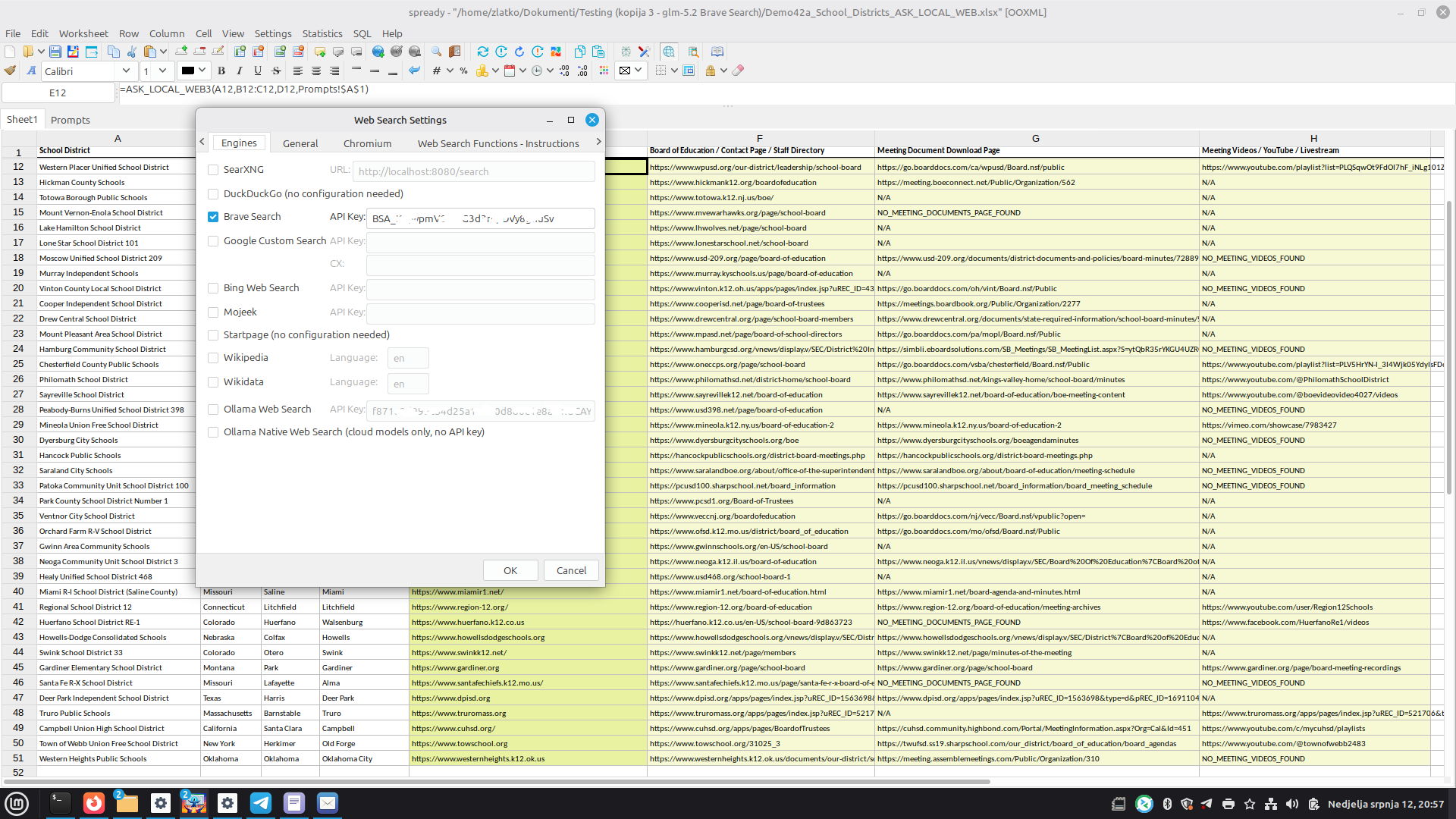
Settings: Only "Brave Search" is enabled, with a valid Brave Search API key entered in the engine configuration. All other engines are disabled.
Web Search Settings -- only Brave Search is enabled.

API tier: Free tier (2,000 queries/month). For higher volumes, paid plans are available. Currently price is $0.005 per query.
Results: The full 50-district × 4-column recalculation completed in 28 hours 32 minutes 28 seconds. All 200 cells were filled with either a valid URL, a N/A marker, or a NO_*_FOUND marker. Zero #APIERR errors were produced — the most stable run of all three engines. Brave Search achieved the highest overall URL yield: 145 out of 200 cells (72%), including a perfect 50/50 on Home Page and a remarkable 13 out of 50 on Meeting Videos — more than triple the video discovery rate of Ollama Web Search. Brave found YouTube channels, Vimeo showcases, and Facebook Live pages that the other engines missed.

Final results with Brave Search -- 28h 32m for 50 districts × 4 columns. Zero #APIERR errors.
Quality summary across 50 districts × 4 columns (200 cells total):
| Output column | Successful URLs | N/A + NO_*_FOUND markers | Hit rate |
|---|---|---|---|
| E -- Home Page | 50 | 0 | 100% |
| F -- Board / Contact / Staff | 48 | 2 (N/A) | 96% |
| G -- Meeting Document Download Page | 34 | 16 (13 N/A + 3 NO_MEETING_DOCUMENTS_PAGE_FOUND) | 68% |
| H -- Meeting Videos / YouTube / Livestream | 13 | 37 (23 N/A + 14 NO_MEETING_VIDEOS_FOUND) | 26% (best of all three engines) |
| Overall | 145 | 55 | 72% (highest) |
Brave Search's standout performance is in the Meeting Videos column: it found 13 YouTube channels, Vimeo showcases, and Facebook Live pages -- more than triple Ollama Web Search's 4 and slightly more than SearXNG's 11. Examples include YouTube channels for Maine School Administrative District 6, Regional School District 18, Western Placer Unified, and Campbell Union High; a Vimeo showcase for Mineola Union Free School District; and a Facebook Live page for Huerfano School District RE-1. Brave also achieved a perfect 50/50 on Home Page discovery -- the only engine to find every single district's official website.
Discussion
Setup complexity: Low. Create a Brave Search API account, copy the API key into Spready's settings, and you're done.
Privacy: Medium. Queries are sent to Brave's API. Brave has a strong privacy track record (they do not profile users), but the data does leave your machine.
Cost: Free for the first 2,000 queries/month. For 50 districts × 4 columns = 200 queries per run, the free tier covers ~10 full runs per month. Beyond that, paid plans start at a few dollars per thousand queries (currently $0.005 per query).
Quality: Excellent. Brave Search achieved the highest overall hit rate (72%) and the best video/livestream discovery (13 URLs vs. 4 for Ollama and 11 for SearXNG). It found YouTube channels, Vimeo showcases, and Facebook Live streams that other engines missed, and achieved a perfect 50/50 on Home Page discovery.
Limitation: The 2,000 query/month free tier is the main constraint. For 50 districts × 4 columns = 200 queries per run, the free tier covers ~10 full runs per month. For production data enrichment pipelines, a paid plan is typically required. Speed is also a consideration: at 28.5 hours for 50 districts, Brave is significantly slower than Ollama Web Search (1h 55m) but dramatically faster than SearXNG (94h 37m).
Engine 3: SearXNG (Self-Hosted Meta-Search)
Settings: Only "SearXNG" is enabled, pointing to http://localhost:8080/search. The "Ollama native web_search" and all other engines are disabled.
Web Search Settings -- only SearXNG is enabled.

SearXNG instance: Self-hosted in Docker on the same machine as Spready. Configuration includes 15+ upstream engines (Google, Bing, DuckDuckGo, Mojeek, Qwant, Startpage, etc.) with JSON format enabled in settings.yml (required for Spready to parse the response).
Results: The full 50-district × 4-column recalculation completed in 94 hours 37 minutes 53 seconds — by far the slowest of the three engines. All 200 cells were filled, but SearXNG produced the lowest overall URL yield: 118 out of 200 cells (59%). It also generated 3 #APIERR errors (socket read failures) and an extraordinary 9,152 Chromium timeouts (each 60 seconds long), which are the primary cause of the extreme runtime. SearXNG returned 111 results per query on average (vs. 10 for Ollama Web Search), but many were irrelevant — FOX News Radio, GitHub repos, tourism sites, and 8kun threads appeared alongside legitimate school district pages. The model had to filter through this noise, which increased both processing time and the likelihood of missing the correct result. On the positive side, SearXNG did find 11 video/livestream URLs (comparable to Brave's 13), including unique Facebook Live discoveries for Drew Central and Ventnor school districts.
Final results with SearXNG -- 94h 37m for 50 districts × 4 columns. The slowest engine by far.
Quality summary across 50 districts × 4 columns (200 cells total):
| Output column | Successful URLs | N/A + NO_*_FOUND markers | Hit rate |
|---|---|---|---|
| E -- Home Page | 38 | 12 (10 N/A + 1 NO_HOMEPAGE_FOUND + 1 #APIERR) | 76% |
| F -- Board / Contact / Staff | 38 | 12 (11 N/A + 1 #APIERR) | 76% |
| G -- Meeting Document Download Page | 31 | 19 (15 N/A + 4 NO_MEETING_DOCUMENTS_PAGE_FOUND) | 62% |
| H -- Meeting Videos / YouTube / Livestream | 11 | 39 (18 N/A + 20 NO_MEETING_VIDEOS_FOUND + 1 #APIERR) | 22% |
| Overall | 118 | 82 | 59% (lowest) |
SearXNG's 59% overall hit rate is the lowest of the three engines, driven primarily by its poor Home Page discovery (38/50, vs. 50/50 for Brave and 49/50 for Ollama). The 94-hour runtime was caused by 9,152 Chromium timeouts (each 60 seconds long) and 522 retries. SearXNG returned an average of 111 results per query -- far more than Ollama Web Search's 10 -- but many were irrelevant noise (FOX News Radio, GitHub repositories, tourism sites, 8kun threads). The model had to filter through this noise, which increased both processing time and the likelihood of missing the correct result. On the positive side, SearXNG did find 11 video/livestream URLs (comparable to Brave's 13), including unique Facebook Live discoveries for Drew Central School District and Ventnor City School District that Brave did not find.
Discussion
Setup complexity: Medium. Requires Docker, SearXNG image, settings.yml configuration (with -json format enabled), and a running instance reachable from Spready.
Privacy: High. All search queries and results stay on your machine; no third-party API sees your queries.
Cost: Free. SearXNG is open-source; the only cost is the electricity to run the Docker container.
Quality: Moderate. SearXNG returned 111 results per query on average — far more than Ollama Web Search's 10 — but many were irrelevant (news sites, GitHub, tourism pages, social media). The model had to filter through significant noise, which increased processing time and occasionally led to missed results. The overall 59% hit rate was the lowest of the three engines, and SearXNG failed to find a home page for 12 out of 50 districts (vs. 0 for Brave and 1 for Ollama).
Limitation: Self-hosted means self-maintained. SearXNG instances occasionally hit CAPTCHAs from upstream engines; rate limits may apply. In our test, 9,152 Chromium timeouts and 522 retries were recorded, making SearXNG by far the most operationally demanding engine. The 94-hour runtime for 50 districts makes it impractical for time-sensitive workflows, though it remains the only fully free and fully private option.
Comparative Analysis
| Aspect | Ollama Web Search | Brave Search | SearXNG |
|---|---|---|---|
| Setup time | ~1 minute | ~5 minutes | ~2 hours |
| Recurring cost | Ollama Pro/Max subscription | Free tier / paid | Free (electricity) |
| Privacy | Medium (Ollama cloud) | Medium (Brave cloud) | High (self-hosted) |
| Speed (50 districts × 4 cols) | 1h 55m (measured) | 28h 32m (measured) | 94h 37m (measured) |
| URL yield | 139/200 (70%) (measured) | 145/200 (72%) (measured) | 118/200 (59%) (measured) |
| Video/livestream discovery | 4/50 | 13/50 (best) | 11/50 |
| #APIERR errors | 0 (after recalc) | 0 | 3 |
| Maintenance | None | None | High (9,152 timeouts, 522 retries in test) |
| Scalability | Per Ollama Cloud plan | Per Brave plan | Limited by self-hosted hardware |
Recommendations
Based on the demonstration above and our broader experience, here are our recommendations for choosing a web search engine in (Un)Perplexed Spready v1.2.6.
Primary Recommendation: Ollama Web Search
If you already have an Ollama Cloud Pro or Max subscription, Ollama Web Search is the clear winner. It is:
- The fastest to set up -- no separate service, no API key, no configuration beyond a checkbox
- The fastest to run -- 1h 55m for 50 districts, roughly 14× faster than Brave Search and 47× faster than SearXNG
- The lowest maintenance -- no Docker containers to update, no upstream engines to debug
- Cost-effective for Ollama subscribers -- included in your existing subscription
The main trade-off is result quality: at 70% overall URL yield, Ollama Web Search trails Brave Search (72%) and is notably weaker in video/livestream discovery (4 URLs found vs. 13 for Brave). For tasks where finding YouTube channels or Facebook Live streams is important, Brave Search may be the better choice. The only reason not to use Ollama Web Search at all is if you are running Ollama locally (web search is a cloud-only feature) or if you have strict data-residency requirements.
Secondary Recommendation: Brave Search (for Quality and Completeness)
If you want the highest result quality and the best video/livestream discovery, Brave Search is the clear winner. It achieved the highest overall URL yield (72%), a perfect 50/50 on Home Page discovery, and found 13 video/livestream URLs — more than triple Ollama Web Search's 4. The 2,000 queries/month free tier covers about 10 full runs of a 50-district spreadsheet, and paid plans are competitively priced for larger workloads.
The main trade-offs are speed (28.5 hours for 50 districts — significantly slower than Ollama Web Search) and the fact that queries are sent to Brave's servers. If those are acceptable for your use case, Brave Search offers the best balance of quality and simplicity.
Tertiary Recommendation: SearXNG (for Privacy-Conscious Users)
If privacy is paramount and time is not a limiting factor, SearXNG is the most private option. It runs entirely on your hardware, supports dozens of upstream engines, and is fully open-source. No queries ever leave your machine.
The main trade-offs are significant: in our test, SearXNG took 94 hours to process 50 districts (vs. 2 hours for Ollama Web Search), produced the lowest URL yield (59%), and generated 9,152 Chromium timeouts. It also returned 111 results per query — far more than Ollama's 10 — but many were irrelevant noise. SearXNG is best suited for users who value privacy above all else and can afford to wait, or for smaller datasets where the extreme runtime is manageable.
The Trade-Off Triangle
When choosing a web search engine, three factors compete:
Privacy
/\
/ \
/ \
/ \
/________\
Cost Quality
- Ollama Web Search optimizes for Speed (1h 55m, 47× faster than SearXNG) and Cost (included in Ollama subscription)
- SearXNG optimizes for Privacy (high, fully self-hosted) at the expense of Speed (94 hours) and Quality (59%, lowest of the three)
- Brave Search optimizes for Quality (72%, highest URL yield + best video discovery) at the expense of Speed (28.5 hours) and Privacy (queries go to Brave)
Your choice depends on which factor matters most for your specific use case.
Conclusion
Web search in (Un)Perplexed Spready has evolved from a complex three-service middleware stack to a one-click integration with Ollama Web Search.
In this article, we demonstrated the same enrichment task -- adding home pages, board of education pages, meeting document pages, and meeting video links for 50 U.S. school districts -- using three different search engines. The clear winner, for users with an Ollama Cloud Pro or Max subscription, is Ollama Web Search: fastest to set up, fastest to run, and lowest maintenance.
For users without an Ollama Cloud subscription, SearXNG and Brave Search remain excellent options, each with their own trade-offs between privacy, cost, and quality.
We encourage you to try all three engines on your own data and see which one fits your workflow best. The same spreadsheet, the same model, the same prompts -- just toggle a different checkbox in Settings -> Web Search Settings.
Further Reading
Matasoft Articles on Web Search in (Un)Perplexed Spready
- Article #150: (Un)Perplexed Spready with web search enabled Ollama models -- Phase 1: Open WebUI + SearXNG setup on Linux
- Article #152: An example of using (Un)Perplexed Spready in a real life use case - Furniture catalog taxonomy classification -- Phase 2: Matasoft Web Search and Web Reader tools
- Article #156: (Un)Perplexed Spready v1.2.X -- Web Search in (Un)Perplexed Spready -- Phase 3: Native web search with 9 engines
External Documentation
- Ollama Web Search documentation -- Official Ollama docs for the web search feature
- SearXNG documentation -- Self-hosted meta-search engine
- Brave Search API documentation -- Cloud search API with privacy focus
- Open WebUI Tools registry -- Community tools including Matasoft's web_search and web_reader
Other Topics
Download the demonstration spreadsheet Demo42a_School_Districts_ASK_LOCAL_WEB.xlsx and try the formulas yourself. Sign in to the (Un)Perplexed Spready download area to get the file. You can download it here: https://spready.matasoft.hr/
© 2026 Matasoft. All rights reserved. (Un)Perplexed Spready is a product of Matasoft.
(Un)Perplexed Spready v1.2.X — A New Chapter in AI-Powered Spreadsheets
- Details
- Written by Super User
- Category: (Un)Perplexed Spready
(Un)Perplexed Spready v1.2.X — A New Chapter in AI-Powered Spreadsheets
Introduction
(Un)Perplexed Spready is a spreadsheet application that combines the power of traditional spreadsheets with advanced artificial intelligence capabilities. Version 1.2.X represents the biggest leap in the application's history, bringing a range of features that elevate data work to an entirely new level.
This version introduces four major improvement areas: Web Search, Vision & Document Processing, SQL Query, and Advanced Statistics.
Best of all, SQL Query and Advanced Statistics functions are completely free! If you are looking for a free statistical software, you are on the right page!
What's New in v1.2.X?
1. Web Search — Search and Process Information from the Internet
(Un)Perplexed Spready already had capability to utilize external web search tools being integrated via Open WebUI endpoints. However, now we are introducing web search functionality in the (Un)Perplexed Spready itself, which does not require any external dependency!
The new Web Search functionality allows you to search the internet directly from spreadsheet cells and process results using AI models. Three formula families are available:
- WEBSEARCH() — Executes web search and sends results to local LLM for summarization
- ASK_LOCAL_WEB() — Local AI decides whether to search the web or answer from knowledge
- ASK_REMOTE_WEB() — Same as ASK_LOCAL_WEB, but uses a remote server

Supported search engines: SearXNG, DuckDuckGo, Mojeek, Startpage, Wikipedia, Wikidata, Brave, Google, Bing.


See the separate article on Web Search functionality for details.
2. Vision — Bring Images into AI Context
You can now use images as input for AI formulas! Supported formats include:
- Local images: JPG, JPEG, PNG, WebP, GIF, BMP
- Online images: HTTP/HTTPS URLs
Example usage:
=ASK_LOCAL1("/path/to/chart.png", "Analyze this chart and describe trends")
This opens possibilities for analyzing charts, tables, receipts, documents, and other visual content directly from the spreadsheet.
See the separate article on Vision functionality for details.
3. Document — Process Documents Without Leaving the Application
The new Document functionality allows loading various document formats into AI context:
- Text formats: TXT, MD, CSV, TSV, SQL, YAML, PY, JS, PAS, SH
- Web formats: HTML, HTM, XHTML
- Documents: PDF, DOCX, DOC, RTF, ODT, EPUB
- Spreadsheets: XLSX, XLSM, XLS, ODS
- Presentations: PPTX, PPT
- Data formats: XML, JSON, GEOJSON
Example:
=ASK_LOCAL1("/path/to/report.pdf", "Summarize the main points of this document")
See the separate article on Document functionality for details.
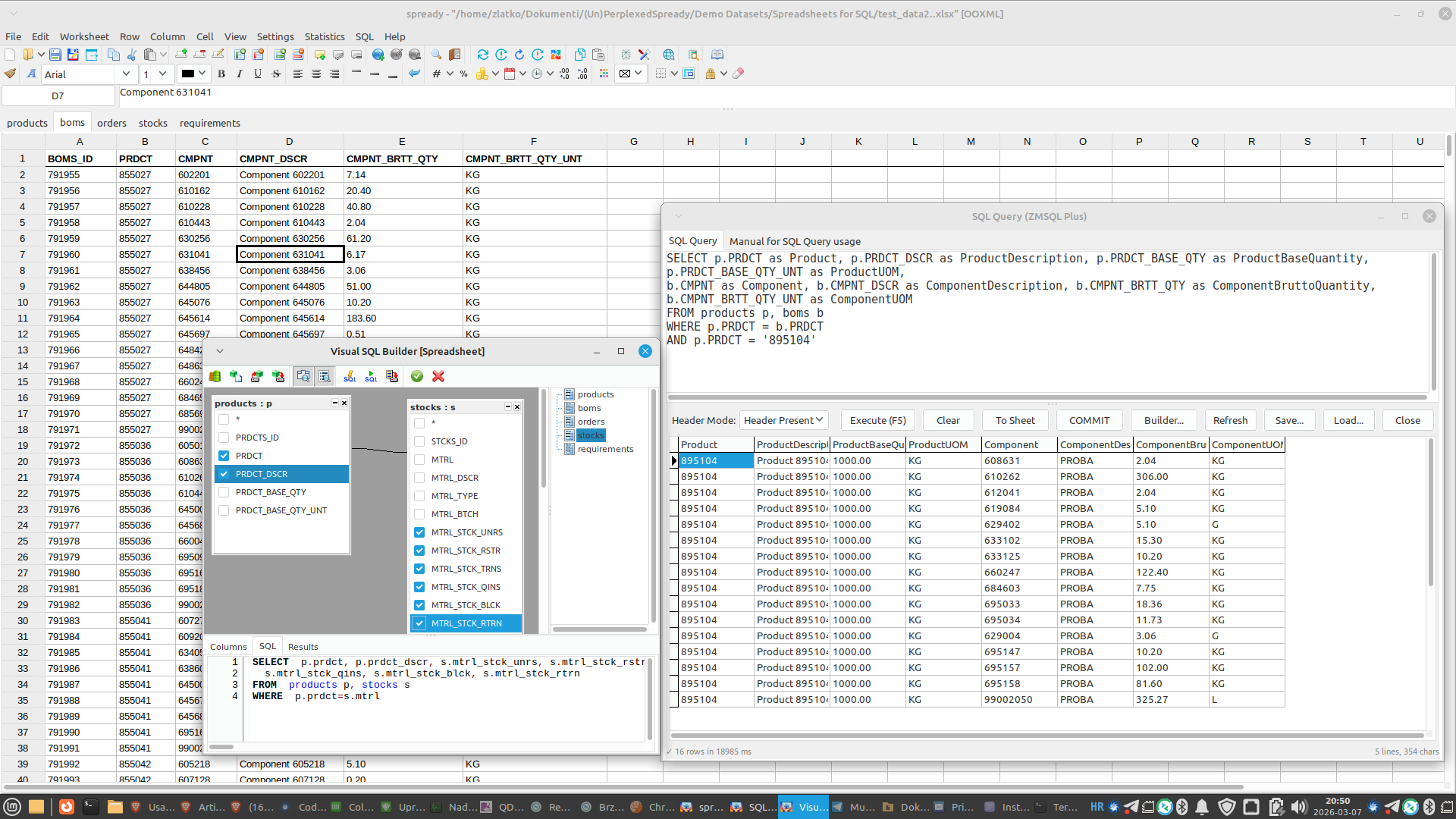
4. SQL Query — Database in Your Spreadsheet
FREE — forever!

Every sheet in your workbook becomes a SQL table. You can write SQL queries to:
- Join data from multiple sheets (JOIN)
- Filter and sort data
- Calculate aggregates (GROUP BY, SUM, COUNT, AVG)
- Create new sheets with results
SQL Query is based on the janSQL engine (by Jan Verhoeven) and ZMSQL package available in CodeTyphon.
See the separate article on SQL Query functionality for details.
5. Advanced Statistics — TyphonStats Integration
FREE — forever!


We integrated TyphonStats (based on LazStats by William G. Miller), a complete statistical package including:
- Descriptive statistics: Mean, median, standard deviation, quartiles
- T-tests: One-sample, paired, independent samples
- Non-parametric tests: Mann-Whitney U, Wilcoxon signed-rank
- Chi-square tests: Goodness of fit, test of independence
- Correlation: Pearson, Spearman
- And much more: ANOVA, regression, factor analysis...
All statistical analyses work directly on data from your sheets — no need to export to CSV or other formats.
See the separate article on Statistical functionality for details.
6. Other Goodies and Improvements
There are many other small improvements making work with Spready easier and more productive:
- Exporting to spreadsheet formats: In previous versions calculated of AI-formulas could be exported as CSV files only. Now you can export it directly into a spreadsheet format, like xlsx.
- Partial recalculation: Now you can trigger partial recalculation of only cells for which AI formula failed i.e. raised an error or returned 'N/A'. This is especially handy when calculating huge spreadsheets.
Free vs. Premium Features
| Feature | Status | Note |
|---|---|---|
| SQL Query | FREE | Free forever |
| Statistics (TyphonStats) | FREE | Free forever |
| Vision (images) | PREMIUM | Requires AI model |
| Document (documents) | PREMIUM | Requires AI model |
| Web Search | PREMIUM | Requires AI model |
| AI formulas | PREMIUM | Requires AI model |
Note: Premium features work with local AI models (Ollama) at no additional cost, or with cloud services (Perplexity, OpenAI) at their prices.
Architecture — Self-Sufficiency and Privacy
(Un)Perplexed Spready v1.2.X is designed for self-sufficiency:
- Only external dependency: Ollama (local AI models)
- No need for Open WebUI or other external services
- Privacy first — data stays on your computer
- Works offline (except Web Search functions)
Your data never leaves your computer when using local AI models. If you choose cloud services, you always have control over what you send.
System Requirements
- Operating System: Windows, Linux, macOS
- RAM: 4 GB minimum (8 GB recommended)
- Disk: 500 MB for application + space for AI models
- AI Models: Ollama with supported models (llama3.1, qwen2.5, mistral-nemo, etc.)
Conclusion
Version 1.2.X brings revolutionary improvements that make (Un)Perplexed Spready a unique tool on the market — a spreadsheet that is simultaneously:
- AI-powered — local AI models for data processing
- Web-connected — search and process information from the internet
- SQL-capable — every sheet is a database
- Statistically powerful — complete statistical package included
- Vision-aware — analyze images and documents
- Private — your data stays on your computer
Download (Un)Perplexed Spready v1.2.X and try the new features!
Credits:
TyphonStats/LazStats — William G. Miller
janSQL engine — Jan Verhoeven
ZMSQL — CodeTyphon community
© 2026 Matasoft.
Further Reading
(Un)Perplexed Spready v1.2.X — Analyze Images Directly in Your Spreadsheet
(Un)Perplexed Spready v1.2.X — SQL Query in spreadsheets
(Un)Perplexed Spready v1.2.X — Process Documents in Spreadsheets
(Un)Perplexed Spready v1.2.X — Professional Statistical Tool for Free
Introduction to (Un)Perplexed Spready
Download (Un)Perplexed Spready
Purchase License for (Un)Perplexed Spready
Various Articles about (Un)Perplexed Spready
AI-driven Spreadsheet Processing Services
Try (Un)Perplexed Spready in Your Browser
- Details
- Written by Super User
- Category: (Un)Perplexed Spready
Try (Un)Perplexed Spready in Your Browser
Pre‑Configured AI Spreadsheet Portal – No Install, Just Start Working
Adopting an AI‑powered spreadsheet sounds great—until you realise you need to wire together an LLM, a web UI, a meta‑search engine, and custom tools just to run your first useful formula with an embedded prompt.
The new online (Un)Perplexed Spready portal removes that barrier: open a URL, start a free session, and test real AI formulas in real spreadsheets—without installing anything or touching infrastructure.
What is (Un)Perplexed Spready?
(Un)Perplexed Spready is a next‑generation spreadsheet that thinks: it embeds advanced language models (LLMs) directly into spreadsheet formulas, so you can extract, classify, enrich, and transform data using natural‑language prompts inside cells.
It combines familiar spreadsheet features (formatting, copy/paste, sorting) with AI‑powered functions like PERPLEXITY, ASK_LOCAL and ASK_REMOTE for tasks that traditional formulas cannot handle, such as free‑text extraction, taxonomy mapping, and intelligent classification.
Until now, the most powerful configurations required setting up your own AI stack—Ollama or Ollama Cloud, Open WebUI, SearXNG, and Matasoft tools—following detailed guides given here: (Un)Perplexed Spready with web search enabled Ollama models and here: An example of using (Un)Perplexed Spready in a real life use case - Furniture catalog taxonomy classification
For many users, however, that level of setup was more than they wanted before simply answering one question: “Can this actually help with my spreadsheets?”
New: Online Spready Portal (Browser Version)
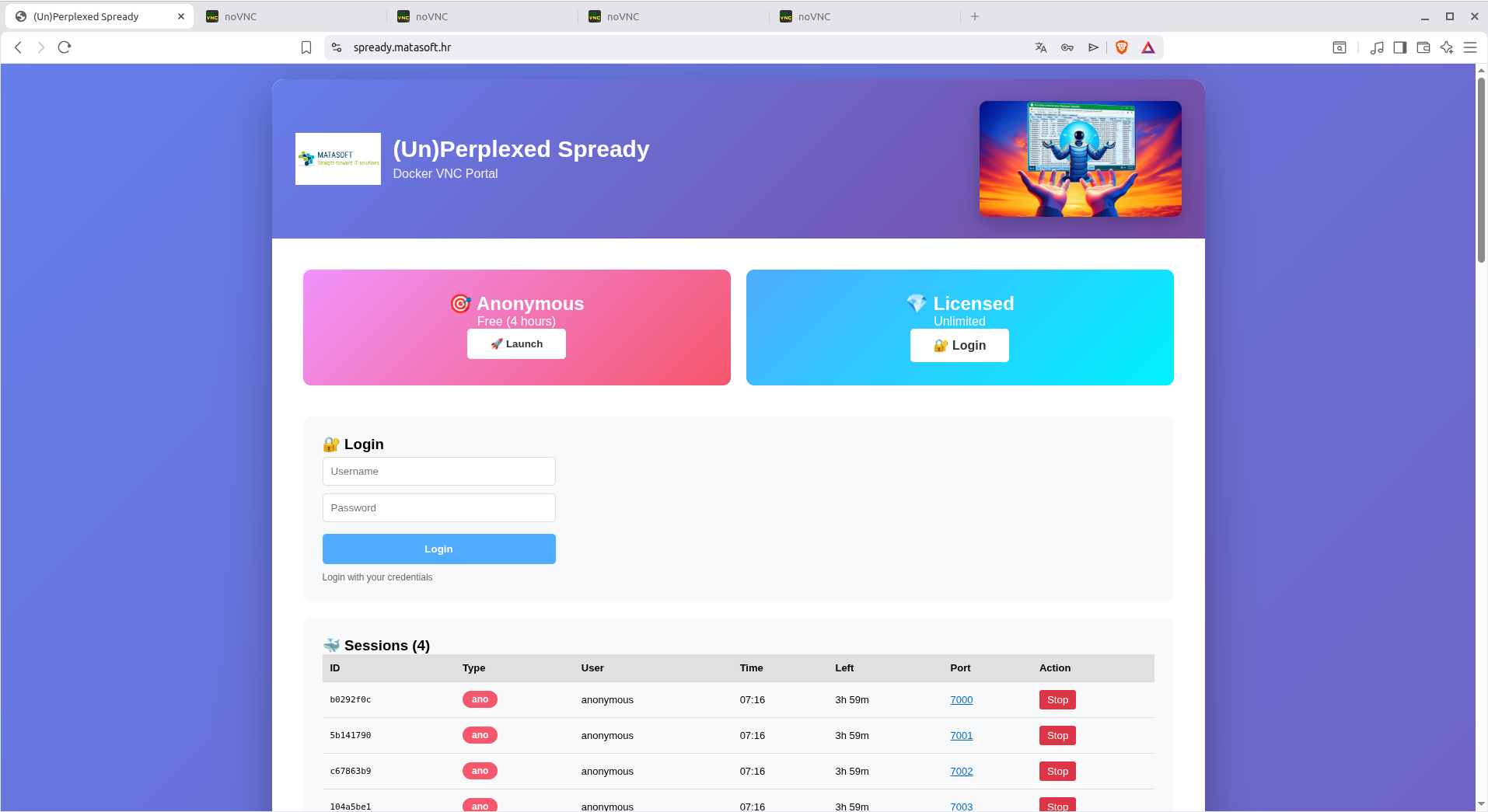
You can now run (Un)Perplexed Spready directly in your browser at:

The portal exposes (Un)Perplexed Spready as a hosted web application with two main modes:
-
Anonymous – Free (4 hours)
-
Start a session without login and use the full AI‑enabled environment for up to 4 hours per anonymous session.
-
-
Licensed – Unlimited
-
Log in with your license for effectively unlimited usage, ideal for regular production‑style work.
-
From the moment your session starts, you see a file list and can open demo workbooks or upload your own spreadsheets, all running on the pre‑configured AI stack.
Everything is Pre‑Configured for You
Behind the scenes, the online portal wires together all the components that previously required careful local setup:
-
Ollama / Ollama Cloud LLM model
-
A strong open‑source model (e.g. GLM‑4.7) is already configured via an Open WebUI endpoint, so ASK_LOCAL / ASK_REMOTE‑style formulas have a working model out of the box.
-
-
Open WebUI endpoint
-
Open WebUI is installed and integrated as the API layer, providing a stable, OpenAI‑compatible interface that Spready uses for its AI functions.
-
-
SearXNG meta‑search
-
A SearXNG instance is set up and tuned for JSON output, allowing AI formulas to perform web‑augmented tasks (like research‑based classification and enrichment) without you touching search engine configuration.
-
-
Matasoft Web Search & Web Reader tools
-
matasoft_web_searchandmatasoft_web_readerare installed and integrated, combining BeautifulSoup + Selenium with JS/SPA heuristics so the LLM can access real page content, not empty shells.
-
All of this is already in place on the portal, so you can focus on what the AI should do in your spreadsheet—not how to connect the pieces.
40+ Demo Spreadsheets Ready to Explore
The portal ships with a rich library of demo workbooks, visible immediately when you connect:
-
Files such as:
-
Demo2_Product Catalog1 (ASK_LOCAL).xlsx -
Demo2_Product Catalog1 (ASK_REMOTE).xlsx -
Demo30_Webinar_Invites (ASK_LOCAL).xlsx -
Demo40_Schools_Research (ASK_LOCAL).xlsx, and many others.
-

-
Each demo contains:
-
Pre‑defined AI formulas (PERPLEXITY / ASK_LOCAL / ASK_REMOTE) with prompts already written.
-
Example input columns (product names, categories, emails, descriptions, etc.) - from very simple to quite complex inputs (like whole taxonomy lookup list ranges).
-
Output columns that show concrete tasks: taxonomy mapping, entity extraction, enrichment, classification, annotation, and more.
-
This makes the portal ideal for learning by example:
-
Open any demo workbook.
-
Inspect the formulas and the prompt text.
-
Change the prompt or tweak the ranges.
-
Hit recalc and see how the AI behaviour changes—no configuration required.
Before you start experimenting, it is advisable that you first read introductory article here: Introduction to (Un)Perplexed Spready and this article: Using (Un)Perplexed Spready where you can learn basics about this software design and usage.
What Can You Do in the Online Sandbox?
The online (Un)Perplexed Spready is not a toy demo; it mirrors real‑world business scenarios.
-
Product taxonomy classification
-
Map thousands of SKUs from an internal taxonomy into a new 2‑level taxonomy using formulas like
ASK_LOCAL3, with product name, internal category, and target taxonomy list as inputs.
-
-
Data extraction from unstructured text
-
Pull attributes (sizes, units, materials, countries, contact details) out of raw descriptions into structured columns using natural‑language prompts.
-
-
Standardisation & reformatting
-
Reformat addresses, normalize names, unify category labels, and standardize free‑text fields at scale.
-
-
Enrichment with web research
-
Use the integrated SearXNG + Matasoft tools so the model can research products, companies, or institutions, then classify or enrich rows based on external information.
-
-
Annotation, labeling, and classification
-
Build multi‑label classification workflows where formulas return multiple categories separated by a delimiter, ready for downstream splitting and analytics.
-
And because it’s still a spreadsheet, you retain full control:
-
Filter, sort, and review outputs.
-
Export to CSV for loading into PIM, ERP, databases, or tools like OpenRefine.
-
Duplicate demo sheets and adapt them to your own datasets.
Few notes:
- ASK_REMOTE is set up without web search tool, you can use it for fast and powerful intelligent data processing when no internet search is required. (Be aware that enabled web search feature dramatically increase processing time!). Of course you can achieve similar result by deleting web search tool from the setup for Ollama model used for ASK_LOCAL, however, ASK_REMOTE will still be faster because it uses direct API endpoint to Ollama, while ASK_LOCAL uses API endpoint of Open WebUI, which is slower. So, use ASK_REMOTE for fast processing, whenever you can!
- All demo spreadsheet are protected, so you cannot save the changes. However you can use Save As to save them under another name and then you can save modifications. You can also upload and download documents.
- Each user has it's own folder with documents. Registered users therefore have private folders, while anonymous sessions all share the same public folder. If you want to try calculate your own spreadsheet with sensitive data, please contact us to provide you registestered private sandbox. Contact us on Sales Contact
Why an Online Version Matters
Even though the full self‑hosted setup is documented in detail, combining Ollama/Ollama Cloud, Open WebUI, SearXNG, and the Matasoft tools can feel complex for many regular users.
The online portal changes the adoption journey:
-
Zero install – no desktop setup, no Docker, no local servers.
-
Fast evaluation – within minutes you’re editing prompts and recalculating formulas instead of reading deployment docs.
-
Realistic stack – you’re testing on the same architectural pattern you would eventually use in production (LLM + web UI + meta‑search + web reader), just hosted for you.
This makes it much easier for you to answer:
-
Does (Un)Perplexed Spready solve my specific spreadsheet problems?
-
Can my team understand and maintain prompt‑driven formulas?
-
Does the AI stack handle our taxonomy, data volume, and complexity?
Only after you’re confident in the answers do you need to decide between continuing online, moving to desktop, or self‑hosting.
Relationship to Desktop Versions
The online portal complements—rather than replaces—the existing desktop offerings:
-
Desktop (Windows / Linux)
-
Download from the “Download (Un)Perplexed Spready” page. [Download (Un)Perplexed Spready]
-
The core spreadsheet functionality is free.
-
Premium AI functions (PERPLEXITY / ASK_LOCAL / ASK_REMOTE) require a license key, which you obtain using the Machine Code shown in the About form.
-
-
Online Portal
-
Browser access at
spready.matasoft.hr.[spready.matasoft] -
Free Anonymous – 4 hours tier for quick tests and experimentation.
-
Licensed – Unlimited tier for regular and heavier usage without time limits.
-
A typical path:
-
Prototype and learn using the online sandbox and demo workbooks.
-
Once convinced, choose:
-
Stay online (licensed unlimited).
-
Or move to desktop + self‑hosted stack for full control and privacy.
-
Who Should Try the Online Version?
The browser‑based (Un)Perplexed Spready is ideal for:
-
E‑commerce and catalog teams
-
Mapping product taxonomies, cleaning supplier feeds, enriching SKUs.
-
-
Data and analytics professionals
-
Turning messy text columns into structured features without having to build a separate ML pipeline.
-
-
Operations and back‑office teams
-
Standardizing entries, classifying tickets or requests, labeling entities directly in the tools they already use.
-
-
Consultants and freelancers
-
Demonstrating value quickly to clients—open a browser, load a sheet, show AI‑driven formulas in action.
-
-
Anyone evaluating AI spreadsheets
-
If you’ve read the setup guides and thought “this looks powerful but a bit much for a first trial,” the online portal is your low‑friction entry point.
-
Getting Started in a Few Minutes
-
Open the portal
Go to https://spready.matasoft.hr in your browser.[spready.matasoft]
- Start a free session
Choose Anonymous – Free (4 hours) to experiment without logging in.


- Pick a demo workbook
Open one of the 40+ demo XLSX files (e.g. taxonomy matching, product catalogs, webinar invites).


Notice: demo spreadsheets are placed in /spready/files folder.
- Adjust screen size to spreadsheet and formulas

- Select a range and execute AI formulas
Depending on how complex AI prompt or input data is, and especially whether web search is used, execution of AI formulas can be fast or extremely slow. Therefore, it is not for inpatient people!
In (Un)Perplexed Spready there is a deliberate deferring mechanism for AI formulas, ensuring that AI calculation is triggered only when user explicitly decides to run it.
There are three buttons available to run AI formulas:


Those commands are also present in the toolbar.

Command "Recalculate Formulas" will trigger calculation of the whole spreadsheet. If there are many cells with AI-driven formulas, depending on the AI model used, your HW specs or Perplexity rate limits (and consequent API calls delay) this might take significant time. Use this option when you are sure that formulas are correctly set.
Command "Recalculate Selected Cell" triggers calculation of only the selected cell. Use it to check whether your formula works correctly.
Command "Recalculate Selected Range" is similar to the previous one, but triggers calculation for multiple selected cells.
Practical advice: Always first start by selecting only one cell or a small range to test the formulas.


-
Inspect results and tweak AI formulas
Check results, look at the AI formulas and prompts, adjust the instructions, and recalculate to see new results. Some formulas are very simple, while some include complex input ranges (e.g. taxonomy lookup list) or complex long prompts placed in another sheet.


- Export resultset into csv file
When you save the spreadsheet, only AI formulas will be saved, calculated values are not saved. If you wish to preserve calculated results, you need to export result into a CSV file.


- Try your own data
When ready, upload a small sample of your own spreadsheet and adapt one of the demos to your structure.
- Decide next steps
If you like the results, continue with licensed online access or move to desktop/self‑hosted deployments using the download and purchase pages on [Purchase License for (Un)Perplexed Spready]
If you get stuck at any point, contact us via Sales Contact for a private sandbox or support.
Further Reading
Introduction to (Un)Perplexed Spready
Download (Un)Perplexed Spready
Purchase License for (Un)Perplexed Spready
Page 1 of 5